How to Calculate Business Use of Home Without Guessing
Oct 25, 2026When someone tells me, "I use about 10% of my home for business," I ask where that number came from. Is it based on a measured spare bedroom, a desk in the living room, or an estimate that includes other areas of the house?
Before applying a percentage to household expenses, you need to identify where business activity takes place and how that space is used. A measurement is a starting point, not proof that the space qualifies for a tax deduction.
Which Areas of Your Home Do You Use for Business?
You may answer customer emails in a spare bedroom, pack orders in one part of a rec room, and keep equipment in the garage. Those are different uses of your home. Identify the areas involved and what you do in each one before combining them into a single percentage.
Do You Have a Dedicated Room or a Clearly Defined Workspace?
A spare bedroom with your desk, computer, and business files is relatively easy to identify. If it measures 10 feet by 12 feet, you have 120 square feet to evaluate. Keep those measurements and a simple sketch of the room. You can then explain exactly what area you included in your calculation.
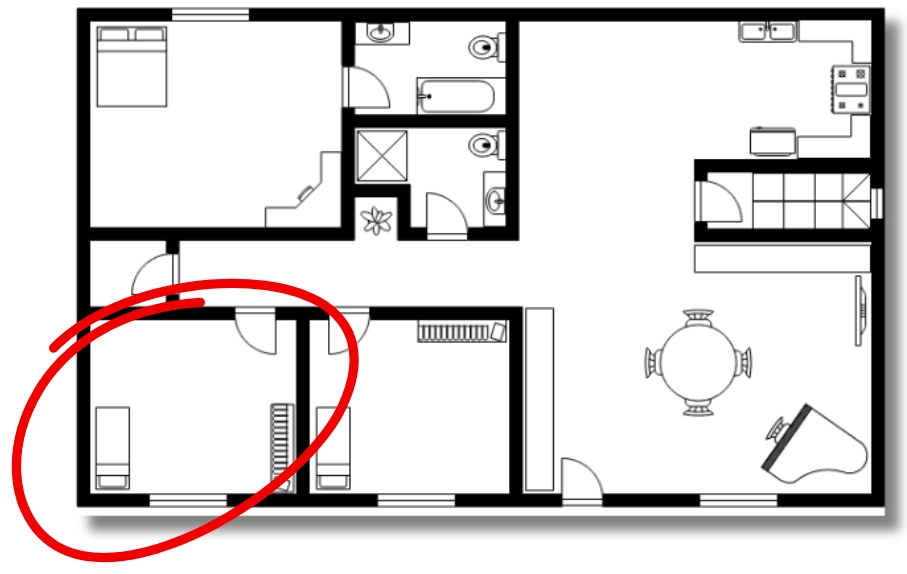
You don't need a separate bedroom to have a clearly defined workspace. A desk and shelves in one corner of a rec room may form a distinct business area, even though your family uses the rest of the room.
I recommend setting aside a consistent, clearly defined workspace wherever practical. It makes the area easier to measure, helps separate business and personal activities, and gives you a clearer record of how the space is used. You don't necessarily need an entire room, but you should be able to identify the business area and explain its use.
In Chapter 19 of my book, The Home-Based Business Guide to Write Off Almost Anything, I compare a dedicated spare bedroom with a workspace in a shared living room. The difference matters because the space you actually use, and how you use it, affects the calculation. Neither a dedicated room nor a measured corner automatically qualifies for a tax write-off.
What If Your Workspace Is Also Used Personally?
A kitchen table used for invoices in the morning and family meals at night serves two purposes. Doing business at that table does not turn the whole kitchen into business space. It also raises a different qualification question from a desk reserved for business.
When business and personal activities share a space, you need to identify the area used for work, when you use it, and what other activities take place there. Those details matter when determining whether the space qualifies and how any eligible expenses are calculated. You cannot simply count the hours you work and assume the entire room qualifies.
Does Your Workspace Qualify Under IRS or CRA Rules?
Having a home-based business does not automatically mean you can claim home office deductions. Eligibility depends on how the workspace is used and the tax rules that apply to your business. Conducting much of your business at customers' locations does not necessarily prevent a home office from qualifying.
What Does the IRS Require for a Home Office in the U.S.?
For most self-employed business owners, the IRS requires a specific area of the home to be used regularly and exclusively for business. Regular use means the space is part of your ongoing business activities, not somewhere you occasionally handle an invoice. Exclusive use means that particular area is not also used for personal activities. It can be a separate room or a clearly identified part of a larger room.
The workspace must also serve a qualifying business purpose. One common way to qualify is for it to be your principal place of business. This can include an office where you regularly handle administrative or management work, provided you have no other fixed location where you conduct substantial administrative or management activities for that business.
Consider a self-employed contractor who performs services at customers' properties but uses a dedicated home office to schedule jobs, prepare invoices, order supplies, and maintain business records. If the office is used regularly and exclusively for the business, and the contractor has no other fixed location for substantial administrative work, it may qualify. Performing the actual service work elsewhere does not automatically disqualify the home office.
Other situations may qualify, including regular client meetings at home that are a substantial part of the business, or a detached structure used exclusively and regularly for business. Special exceptions to the exclusive-use rule also exist for certain inventory storage and daycare activities.
What Does the CRA Require for Business Use of Home in Canada?
For self-employed business owners in Canada, the CRA provides two alternative ways a home workspace can qualify.
The workspace must either be your principal place of business, or it must be used exclusively to earn business income and used regularly and continuously to meet clients, customers, or patients in person.
That distinction is important. If your home is your principal place of business, the workspace does not necessarily have to be used exclusively for business. A room that also has personal use may still qualify under this condition. Personal use must then be considered when calculating the eligible portion of household expenses.
Consider the contractor who works at customers' properties but handles work orders, scheduling, bookkeeping, and supply purchases from home. That home workspace may still be the principal place of business, depending on how the business operates. The important question is where the business is mainly run, not simply where the physical work takes place.
If your home is not your principal place of business, the second qualification route requires both exclusive business use and regular, ongoing in-person client meetings. Simply doing occasional paperwork at home would not meet that alternative test.
How Do You Calculate the Percentage of Your Home Used for Business?
The business-use percentage represents the portion of your home used for business. It is determined by comparing the size of the qualifying business workspace with the overall size of your home. The same home office can represent a different percentage in a smaller house than in a larger one.
Square footage is a common method for calculating this percentage. The measured area of the business workspace is divided by the total area of the home. Comparing the number of rooms can also be a reasonable method in certain circumstances, particularly when the rooms are similar in size.
What matters is which areas are included in the calculation. A dedicated home office is different from a desk occupying only part of a living room. The total area of the home is equally important. Excluding household areas simply to increase the business-use percentage can produce a misleading result. The calculation needs to reflect a reasonable method consistent with the applicable tax guidelines.
Keep a record of the measurements and the areas included. A simple floor plan or notes showing how the percentage was determined can help explain the figure when reviewing household expenses. Any additional business space, such as a garage or storage area, needs to be evaluated before including it in the calculation.
The resulting percentage establishes the business share of your home's area. It can then be used when calculating eligible household expenses, subject to the applicable tax rules and any adjustments for personal use.
In Chapter 19 of my book, The Home-Based Business Guide to Write Off Almost Anything, I cover in more detail how this business-use percentage is determined and why the space actually used for business matters when applying IRS and CRA guidelines.
How Do You Calculate the U.S. Home Office Deduction?
Self-employed business owners in the United States can calculate a qualifying home office deduction using either the IRS simplified method or the regular method. The simplified method uses a set amount per square foot of qualifying business space. The regular method uses actual eligible household expenses and the portion of the home used for business.
How Does the IRS Simplified Method Work?
The IRS simplified method allows US$5 per qualifying square foot, up to a maximum of 300 square feet. For an office that qualifies throughout the year, this produces a maximum calculated amount of US$1,500.
For a 120-square-foot home office, the simplified method produces US$600 for a full year of qualifying use.
The amount you can claim may be lower if the office was used for only part of the year or if the business-income limitation applies. Any amount that cannot be deducted under the simplified method cannot be carried forward to another tax year.
This method replaces the calculation of actual home-office expenses. Household costs such as utilities, insurance, and home depreciation cannot be added to the simplified deduction. Other ordinary business expenses, such as advertising and supplies, remain subject to their usual deduction rules.
How Does the IRS Regular Method Work?
The regular method calculates the business portion of actual eligible household expenses. This is where the business-use percentage of the home becomes important.
For example, a qualifying 120-square-foot office in a 1,500-square-foot home represents 8% of the home's area. That percentage may be used to allocate eligible household expenses that benefit both the home and the business. Utilities and home insurance are examples of shared expenses that may qualify.
Expenses directly related to the business workspace can receive different treatment. Painting or repairing a room used exclusively as a qualifying home office, for example, may be treated as a direct expense rather than allocated across the entire home.
The regular method can also include depreciation on the business portion of an owned home, subject to IRS rules. Depreciation deserves careful consideration because it can affect the tax treatment when the home is sold.
The business-income limitation still applies. However, certain eligible expenses that cannot be deducted in the current year may be carried forward to a future year when the regular method is used, subject to the applicable limits.
The simplified method is not automatically the better choice because it requires less calculation. Comparing the available deduction under each method, based on actual household expenses and the applicable limits, gives a clearer picture of which approach makes sense for the business.
How Do You Calculate Business-Use-of-Home Expenses in Canada?
Self-employed business owners in Canada calculate business-use-of-home expenses using actual eligible household costs and the portion attributable to their business. Unlike the IRS simplified method, the CRA does not provide an equivalent flat-rate deduction per square foot for self-employed business owners.
The business-use percentage depends on the area of the home used for business and how that space is used. Once the appropriate percentage is established, it can be applied to eligible household expenses. Heating, electricity, and home insurance are examples of costs that may be allocated. Rent may be included for tenants, while property taxes and eligible mortgage interest may apply to homeowners.
The calculation must reflect actual expenses and reasonable business use. Having a qualifying home office does not mean every household expense can be included. The type of expense and its connection to the business matter just as much as the percentage.
The CRA also limits the deduction to the income available from that business before business-use-of-home expenses are deducted. These expenses cannot create or increase a business loss. Eligible amounts that cannot be claimed because of this limit may be carried forward to future years and applied against income from the same business, provided the qualifying conditions continue to be met.
Capital cost allowance (CCA) on the business portion of an owned home is another consideration. However, claiming CCA can affect the tax treatment when the property is sold, including potential capital gains and recapture. This requires careful consideration before making a claim.
How Does Personal Use of a Shared Room Change the Calculation?
In Canada, a qualifying workspace that is also used for personal activities may require an adjustment for the time it is used for business. This applies when the workspace qualifies as the principal place of business, as explained earlier.
The 120-square-foot office in a 1,500-square-foot home used in the earlier example represents 8% of that home's area. This is an illustrative measurement, not a standard CRA percentage.
If a qualifying shared workspace of that size is used for business six hours each day and for personal activities during the remaining hours, the business-use portion would be 2% of otherwise eligible shared household expenses under those assumptions (8% × 6/24).
That calculation assumes the same usage every day. If the business operates only five days a week or for part of the year, the calculation must also reflect those periods.
A shared workspace can require more recordkeeping than expected. The business owner must support both the area used and the time devoted to business activities, even when the resulting expense allocation is relatively small. A clearly defined workspace can make those records easier to maintain.
Which Household Expenses Can You Claim for Business Use of Home?
A qualifying home-based business can include the business portion of eligible household expenses as tax write-offs. These are costs associated with operating and maintaining the home, not just purchases made specifically for the home office.
Under the IRS regular method and Canada's business-use-of-home rules, the household expenses to review include:
- Heating and utilities: Electricity, natural gas, heating oil, water, and other eligible utility costs.
- Home insurance: The business portion of insurance covering the home.
- Rent: A portion of the rent if you lease your home.
- Property taxes: The business portion of property taxes paid by homeowners.
- Mortgage interest: The interest paid on a home mortgage, not the principal used to repay the loan.
- Cleaning and maintenance: Cleaning supplies, cleaning services, and routine upkeep related to the business workspace.
- Home repairs: Repairs to the office itself or to household systems that also serve the business area.
The business portion of these expenses is determined by how the home is used. Expenses relating only to the business workspace can receive different treatment from expenses shared by the entire household. The IRS simplified method does not add actual household operating expenses to its fixed square-foot deduction.
How Do You Apply Your Business-Use Percentage to a Household Bill?
Once the business-use percentage of your home has been established, it can be applied to eligible household expenses such as electricity, heating, and home insurance.
Instead of treating the entire bill as a personal living expense, the qualifying business portion becomes an expense of operating your home-based business. The remaining portion stays a personal household expense.
A business tax write-off reduces the income used to calculate your income tax. It does not mean receiving the full amount of the expense back as a refund. The benefit comes from deducting the eligible business portion of an expense you already pay.
What Is the Tax Advantage of Operating a Business from Home?
One of the tax advantages of operating a home-based business is that a percentage of everyday household expenses can become a business tax write-off. These are expenses you already pay to operate and maintain your home, whether you have a business or not.
For example, when the motor in my home's air exchanger stopped working, replacing it and having it serviced cost $500, including sales tax. That's a household repair I would have paid for anyway, using money I had already paid income tax on.
But because the air exchanger also served the space where I operated my home-based business, I included a prorated portion of that $500 repair as a business tax write-off. Instead of treating the entire cost as a personal expense, the business portion became part of my business expenses.
The same principle applies to other household costs. Your furnace heats your home, including your business workspace. Your electricity powers the lights and equipment you use for business. Even certain repairs and maintenance expenses can have a business portion.
This is one of the tax secrets of operating a home-based business. Some of the household expenses you've always paid personally can also help reduce your taxable business income when the business portion meets the applicable tax rules.
The advantage isn't limited to buying office equipment or supplies. It's recognizing the business portion of the everyday household expenses you're already paying.
Can a Garage, Shed, or Storage Area Count as Business Space?
Over the years, I've been asked many times whether a garage, shed, or storage area can be included when calculating business use of home. This is particularly relevant to home-based business owners who keep equipment, tools, supplies, or inventory at home.
One reader of my book contacted me about his lawn-care business. His homeowners association (HOA) did not allow him to park his work trailer in the driveway, so he stored the trailer and landscaping equipment in his garage. He wanted to know whether the garage could be included as business space.
The important question was how much of the garage was actually being used for business. If part of the garage holds business equipment while another part is used for a family vehicle or household storage, those uses need to be separated. The HOA restriction explains why the equipment was kept inside, but it does not determine the tax treatment.
A contractor who performs work at customers' properties may also use a spare bedroom for scheduling and invoicing while storing tools and equipment in part of the garage. Both areas are connected to the business and deserve consideration when reviewing how space at home is used.
A home-based retailer presents another situation. The garage or shed might be used to store merchandise, packaging materials, and orders waiting to be shipped. This is business inventory rather than equipment used to provide services.
That distinction matters under IRS rules. In the United States, retail and wholesale businesses can qualify for a special inventory storage exception when the home is their only fixed business location and the storage area meets the IRS requirements. The same exception does not apply to lawn-care equipment or tools used to provide services.
For service businesses, garage space must meet an applicable home-office qualification test. The IRS also has provisions for detached garages, sheds, and workshops used regularly and exclusively for business, even when they are not the principal place of business.
In Canada, the CRA applies its own business-use-of-home requirements. There is no equivalent inventory storage exception. Whether the space is used for merchandise, tools, or equipment, the business owner must establish that the space meets the Canadian qualification rules before including related expenses.
If you're reading this in the U.S. or Canada, start by identifying the part of your garage or storage area actually used for business. Measure that space, note any personal use, and keep a simple sketch or record showing what is stored there. When calculating your business-use percentage, make sure the garage is treated correctly under the tax rules that apply to you.
This gives the business owner a reasonable basis for including garage or storage space in the calculation, rather than simply estimating a percentage.
What About Your Other Business Write-Offs?
Business use of home is just one area to consider. Other expenses may also qualify as business tax write-offs. The important thing is understanding what applies to your business and what records you need to support those expenses.
For a closer look at common home-based business write-offs in Canada and the United States, explore The Home-Based Business Guide to Write Off Almost Anything. It explains the expenses to consider, how business use matters, and the records behind them.
If you want guided help organizing and maintaining your business records, Home Business Tax Secrets is a membership built around that work. The Bookkeeping Clarity Roadmap helps you document your business activities, including how you use your home, and establish a practical bookkeeping direction.
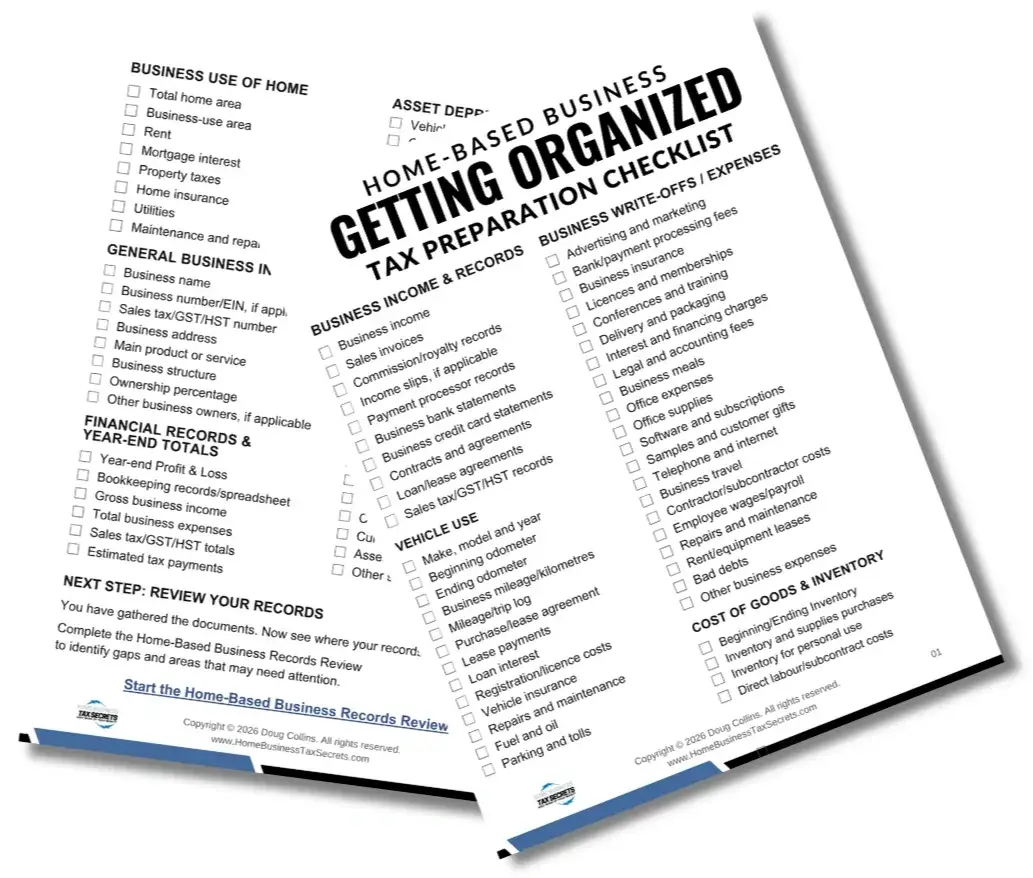
Tax Preparation Checklist
Know What to Gather Before Tax Time

Updated and Expanded Second Edition
You May Be Paying More Income Tax Than Necessary